Your First Dance Performance: Watch the Space Between Dancers
Watch the space between dancers to see how distance, formations and crossings shape relationships on stage, without needing to know the steps.
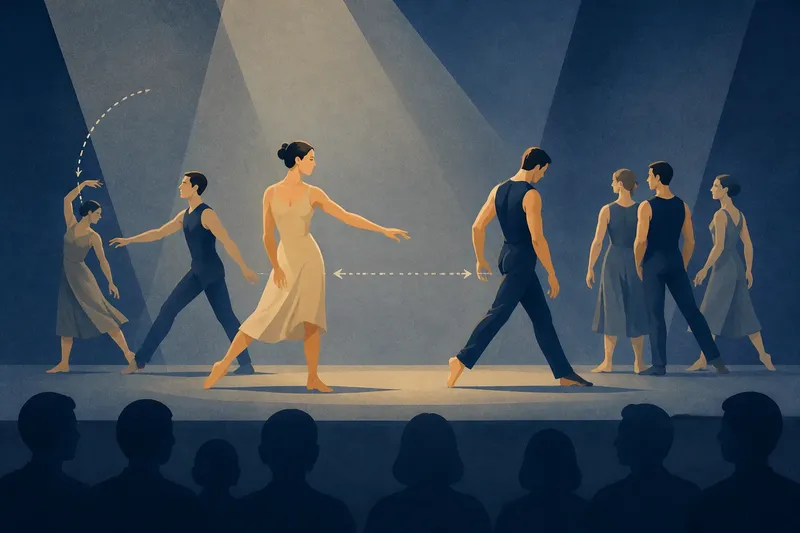
At your first dance performance, watch how dancers use distance and direction to shape a relationship. In a duet, a performer might approach, stop short, then turn away; that sequence gives you something concrete to follow even if you do not recognise the style or know what the choreography means.
Keep your attention on what bodies do: who moves, who stays still, where they face, and how a formation changes. Treat your interpretation as a possibility rather than a verdict. The stage is a little like a crowded table: shifting one object can change how the whole arrangement reads.
How can you read space between dancers?
Begin with the visible arrangement, not a guess about the story. Are the dancers in a line, a cluster, a circle or separate parts of the stage? Then notice how they face and whether their movement changes that pattern. These details let you describe the choreography plainly before deciding what it might suggest.
Distance has no fixed meaning. Two dancers far apart may seem divided, or they may be preparing to travel towards each other. A close formation can suggest intimacy, pressure or simply a precise design. Look at the next action to see which possibilities become more persuasive.
Follow one dancer if the full stage picture feels busy. Track where they enter, whom they pass, and where they end up. You can return your attention to the group when their path changes its arrangement.
What should you notice when a formation changes?
When someone joins a group, watch how the others respond. They might shift together, make room for the newcomer, or hold their positions while the newcomer finds a place. Each action gives a different impression of the group’s organisation, but one moment alone need not settle its meaning.
During a crossing, notice who moves and who remains still, then check what the crossing changes. The dancers may exchange places, separate a pair or create a new line. The result matters more than simply seeing two people pass.
Imagine a duet that begins with two dancers facing one another. One crosses behind the other and stops on the opposite side; the visible result is an exchange of places, not a direct approach. If the dancer then turns back towards their partner, the crossing may feel like a detour within their connection. The later movement gives you a reason to revise your first impression.
Who controls the stage picture?
The dancer in the middle is not always the focus. Look for where the other performers direct their faces, whether they leave someone room, and whose movement sets the group in motion. Attention can shift without anyone changing position.
Notice how freely each dancer can move. One person may travel across the stage while others make room; another may repeat a narrow path at the edge. Such contrasts can suggest different degrees of authority or freedom, though they may also be part of the choreography’s design.
Say a group holds a line while one dancer repeatedly steps out and the others turn to follow. You see the line break and the group’s attention shift; if the dancer later returns and the others face forward, the moment may read as a temporary interruption rather than a lasting separation.
What questions help you follow the choreography?
What changed when a dancer joined the group?
Notice whether the group moved together, made room or stayed fixed. That response shows how the formation changed, while its meaning remains open to the next moment.
Who moved during the crossing?
Track the moving dancer’s route and the positions left behind. If the group keeps its arrangement, the crossing may be a passing detail; if the formation changes, it has altered the stage picture.
Where do the dancers direct their attention?
Watch faces and bodies as well as feet. If several performers turn towards one person, your attention may follow theirs; if they face elsewhere, the most prominent movement may not be the group’s focus.
Does the next movement change your first impression?
Compare the action that follows with what you initially thought a gesture meant. A retreat followed by a return, for instance, can make separation seem temporary rather than final.
How can you describe a dance without overinterpreting it?
Separate observation from interpretation. “The group moved apart when one dancer entered” describes an action; “the group rejected them” assigns a motive. You can consider both, but keeping them distinct makes it easier to adjust your reading if the choreography develops differently.
- Check whether the dancers begin in a line; if they stay aligned, watch for a later shift, and if they do not, follow the new formation.
- Check whether a newcomer is met by a shared movement; if the group shifts, note who makes room, and if it stays still, follow where the newcomer goes.
- Check whether a crossing changes the dancers’ positions; if it does, describe the new arrangement, and if it does not, attend to the route and timing.
- Check which way the group faces; if several dancers turn towards one person, follow that focus, and if they face different ways, track one dancer’s path.
- Check whether a dancer repeats the same route; if the pattern recurs, consider what it establishes, and if it changes, notice who or what redirected it.
- Check whether the music pauses while the movement continues; if it does, notice the contrast, and if both stop, observe how the stillness changes the stage picture.
What can you remember after the curtain call?
Choose one moment that stayed with you, such as a group changing formation or a dancer passing behind a partner. Describe the movement and the arrangement before and after it. You do not need to claim that you understood every gesture; a precise observation is a useful account of what you saw.
For a first dance performance, the phrase “space between dancers” is a straightforward starting point: use it to follow a change in formation, direction or attention, then let later movement refine your interpretation. A clear description gives you something specific to carry into the next performance, even when the choreography leaves its meaning unresolved.